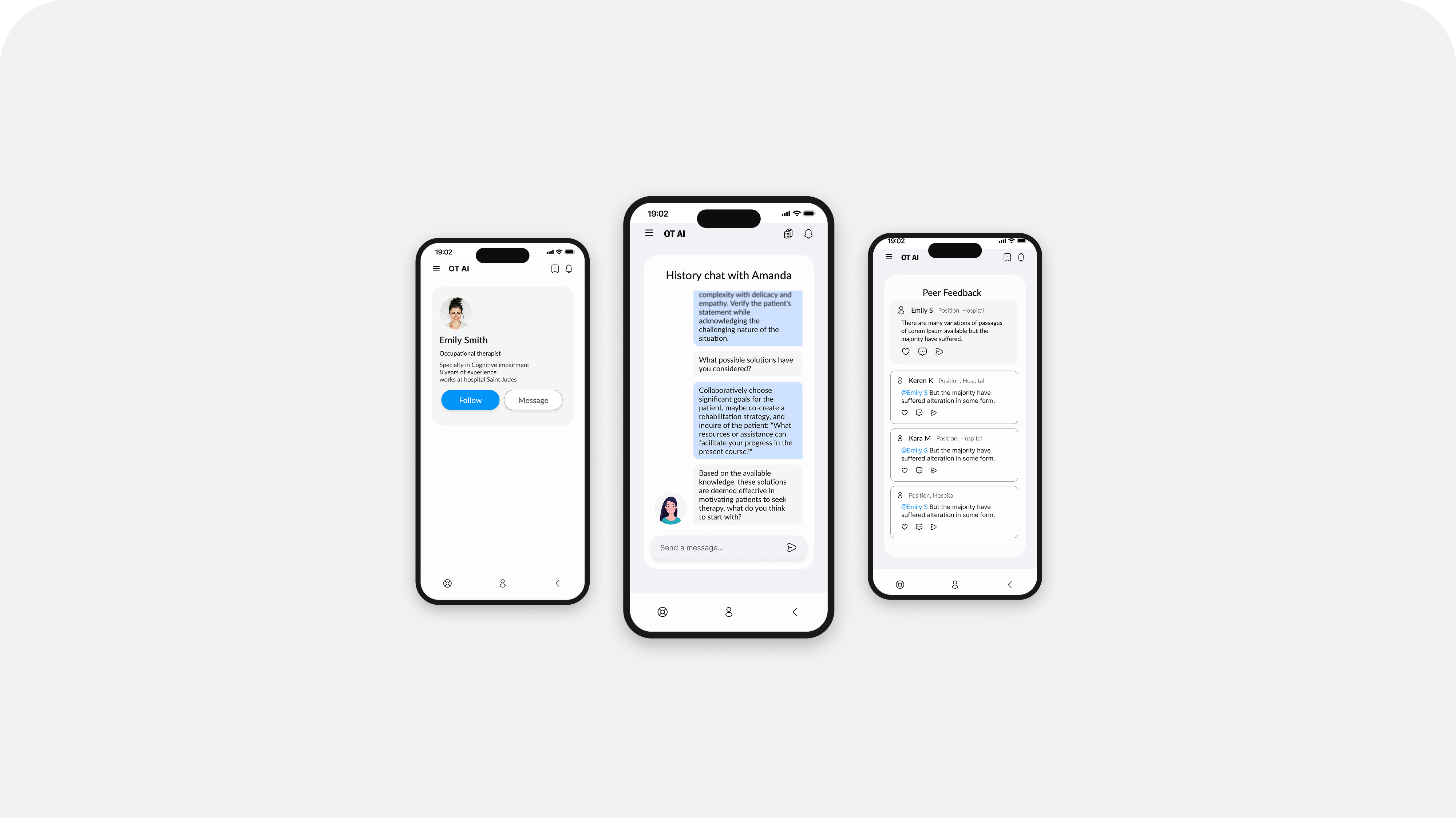
O.T AI Platform
Professional decision support & reflective AI platform for occupational therapists.
Outcome
The AI was built as a ChatGPT agent on the findings from my research: it asks therapists reflective questions before it offers answers. I then evaluated 36 real therapist conversations against 8 clinical rubrics. They showed where the agent still fell short: in some conversations it answered too early or didn't fit the situation, and some therapists got frustrated.
Activity 7 in-depth interviews · 2 group sessions · 36 real conversations evaluated · 8 clinical rubrics
Problem
The team assumed junior therapists lacked knowledge and needed fast answers. The research showed something else: therapists at every level, including ones with almost 20 years' experience, can't discuss sensitive patient cases with anyone, so they're left to work through hard sessions alone.
My role
Sole UX/UI designer and researcher in an academic team (University of Haifa, Meuhedet HMO, Shenkar), 2022–2026. I owned the research, recruitment, interviews and transcription, the user flows, the persona and the app UI, and later the evaluation of the agent's conversations.
Key decisions
-
Interviews over more survey data.
The committee wanted survey answers, and the team felt the survey, group sessions and workshops were enough. I pushed back because we still didn't know what therapists needed. I designed the protocol, recruited participants, and ran and transcribed 7 interviews.
Read more in the full process → -
An AI that asks questions instead of giving answers.
We dropped the answer search engine because therapists said they wanted to be guided through their own thinking. An answer helps with one case, while a reflective question helps the therapist with the next one too.
Read more in the full process → -
A peer community next to the bot, anonymous by default.
A bot alone wasn't enough for therapists to feel confident, and patient privacy made sharing risky. So therapists can share a whole bot session with verified peers for feedback, with partial anonymity switched on from the start.
Read more in the full process →
What I got wrong
I designed the full app UI expecting the project to get more funding and move into development. It didn't, and the product became a ChatGPT agent instead, so the screens were never built. What carried over was the behavior I'd defined from the research. I learned that when a product's format isn't settled yet, the most durable thing to design first is how it should behave.
What I'd do differently
I'd write the conversation rules early and test them with therapists as scripted conversations, before putting time into high-fidelity screens.